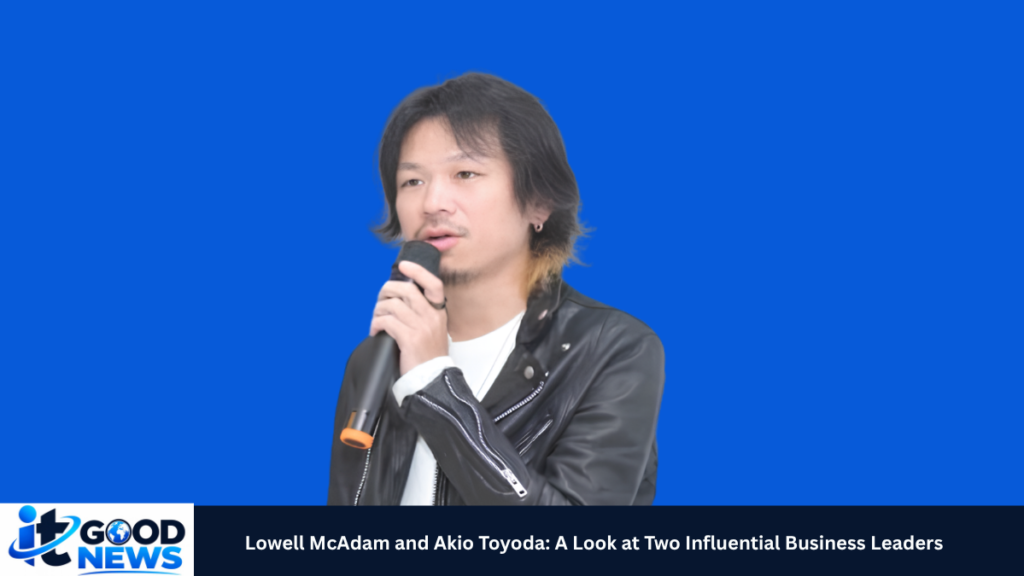

Lowell McAdam and Akio Toyoda are two prominent names from very different corners of the global business world. McAdam became widely recognised through his leadership in the telecommunications industry, while Toyoda built his career within one of the world’s most important automobile companies. Although their industries and professional backgrounds are different, both executives have been associated with major periods of change, technological development and corporate transformation.
Their careers are also interesting because they represent two distinct approaches to leadership. Lowell McAdam spent much of his professional life navigating the rapid evolution of communications, wireless technology and digital services. Akio Toyoda, meanwhile, worked within the automotive industry during a period marked by technological disruption, global competition, changing consumer expectations and the transition toward electrified vehicles.
Understanding Lowell McAdam and Akio Toyoda means looking beyond their job titles. Their professional stories provide an opportunity to examine how senior executives respond to changing markets, manage large organisations and preserve a company’s long-term identity while dealing with new challenges.
Who Is Lowell McAdam?
Lowell McAdam is an American business executive best known for his leadership at Verizon Communications. He spent decades working in the telecommunications sector and eventually became one of the company’s most recognisable senior executives. His career developed alongside major changes in wireless communication, making his experience closely connected with the expansion of mobile technology.
Before becoming Verizon’s chief executive, McAdam held several important leadership positions within the company. He was particularly associated with Verizon Wireless, where he served as president and chief executive officer. During this period, the wireless market was becoming increasingly important to consumers and businesses, and competition between major telecommunications companies was intensifying.
McAdam eventually became chairman and CEO of Verizon Communications in 2011. His tenure placed him at the centre of decisions involving wireless networks, broadband, media and technology. Under his leadership, Verizon also pursued significant strategic moves intended to expand the company’s position beyond traditional telecommunications services.
Lowell McAdam’s Leadership at Verizon
One of the defining features of McAdam’s career was his involvement in Verizon’s wireless business. Mobile phones had changed dramatically during his professional lifetime, moving from specialised communication devices toward smartphones that became central to everyday life. Telecommunications companies therefore had to invest heavily in network infrastructure and capacity.
McAdam’s leadership period included the rapid growth of smartphones and mobile data. The popularity of devices such as Apple’s iPhone created new demands for faster and more reliable wireless networks. Verizon’s investment in its network became an important part of its competitive strategy, while the broader industry shifted from voice-based communication toward data-driven services.
His tenure also included Verizon’s acquisition of Yahoo and AOL assets, reflecting an effort to build a larger digital media presence. The strategy demonstrated how traditional telecommunications companies were exploring opportunities in online advertising and content. Although the media business later faced significant challenges, the move illustrated the changing boundaries between telecommunications, technology and media.
Who Is Akio Toyoda?
Akio Toyoda is a Japanese business leader and member of the Toyoda family, which has a historic connection with Toyota. Born in 1956, he joined Toyota Motor Corporation and eventually became one of the most influential figures in the company’s modern history.
Toyoda became president of Toyota in 2009, at a difficult time for the global automobile industry. The company was dealing with the consequences of the global financial crisis, while the automotive sector was becoming more competitive internationally. His appointment was particularly significant because it placed a member of the founding family in the company’s top leadership position.
During his years as president and chief executive, Toyoda frequently emphasised the importance of producing vehicles that people genuinely wanted to drive. He also became known for his interest in automobiles as products rather than treating them purely as financial assets or manufacturing outputs.
Akio Toyoda and Toyota’s Global Position
Toyoda’s leadership came during a period when Toyota was already one of the world’s largest automobile manufacturers. The company had established a global manufacturing and sales network and was widely recognised for production efficiency, reliability and hybrid technology.
The Toyota Prius had already helped establish Toyota as a major player in hybrid vehicles. Under Toyoda, the company continued developing electrification while maintaining a broader approach to vehicle technology. Toyota invested in hybrids, plug-in hybrids, battery-electric vehicles and hydrogen fuel-cell technology rather than concentrating exclusively on one solution.
This approach became an important part of Toyoda’s public leadership philosophy. He repeatedly argued that different markets have different infrastructure, energy systems and consumer requirements. As a result, Toyota’s strategy involved multiple powertrain technologies rather than assuming that one technology would immediately suit every country and customer.
Different Industries, Similar Leadership Challenges
At first glance, Lowell McAdam and Akio Toyoda may appear to have very little in common. McAdam operated in telecommunications, while Toyoda worked in automobile manufacturing. Their companies also have different products, customers and operating structures.
However, both faced industries experiencing rapid technological transformation. Telecommunications moved quickly toward smartphones, mobile data and digital platforms. Automotive companies have been dealing with electrification, software, connected vehicles, autonomous-driving research and changing expectations around mobility.
For executives operating at this scale, technological change creates both opportunities and risks. Investing too slowly can leave a company behind competitors, while investing heavily in an emerging technology that develops differently than expected can create financial and strategic difficulties.
Their Views on Technology and Change
McAdam’s career was closely connected to the expansion of communication technology. During his leadership years, consumers increasingly expected fast mobile internet, widespread network coverage and seamless digital connectivity. Telecommunications companies had to build infrastructure capable of supporting enormous increases in data usage.
Toyoda approached technological change from the perspective of automobile manufacturing and mobility. His public comments frequently highlighted the importance of understanding how vehicles fit into people’s lives. Rather than viewing technology simply as a race for specifications, he often discussed the relationship between cars, drivers and society.
The difference is revealing. McAdam’s industry was primarily concerned with connecting people and information, while Toyoda’s industry focused on physical mobility. Yet both faced the same fundamental leadership question: how should a large established company adapt when technology changes the expectations of its customers?
Corporate Culture and Long-Term Thinking
Another interesting comparison between Lowell McAdam and Akio Toyoda concerns corporate culture. Large companies often develop systems and traditions over many decades, and senior executives must balance those traditions with the need to adapt.
McAdam’s telecommunications career involved managing a company that had grown through technological and corporate changes. Verizon operated on a huge scale, requiring decisions involving infrastructure, customers, employees and investors. Leadership in such an environment depends heavily on coordinating different parts of an organisation.
Toyoda inherited a company with an especially distinctive corporate philosophy. Toyota’s production methods, quality principles and long-term approach became influential throughout global manufacturing. As a member of the founding family, Toyoda had an additional responsibility to preserve the company’s identity while preparing it for a rapidly changing automotive market.
What Makes Their Careers Interesting?
The story of Lowell McAdam and Akio Toyoda is interesting because neither career can be understood simply through a list of positions. Both executives operated during periods when technology fundamentally changed their industries.
McAdam’s professional journey reflects the transformation of telecommunications from conventional telephone services into a mobile and digital ecosystem. The rise of smartphones, wireless data and online services created opportunities that would have been difficult to imagine when many traditional telecommunications systems were first developed.
Toyoda’s career similarly reflects the transformation of the automobile industry. Cars are increasingly becoming software-connected products, while environmental regulations, battery technology and alternative powertrains are changing the industry’s competitive landscape. His leadership therefore involved questions that went far beyond traditional vehicle manufacturing.
Lowell McAdam and Akio Toyoda Today
McAdam’s most prominent executive chapter was at Verizon, where he served as chairman and CEO before stepping down from the role. His career remains associated with the development of Verizon’s wireless business and its efforts to expand into digital media and technology.
Toyoda’s role also evolved after his long tenure as Toyota’s president and CEO. He became chairman of Toyota’s board, while the company’s executive leadership transitioned to Koji Sato in 2023. Toyoda has continued to play an important role in Toyota’s corporate direction and public identity.
Their later careers demonstrate an important aspect of executive leadership: stepping away from the CEO position does not necessarily mean disappearing from the organisation. Experienced leaders can continue influencing corporate strategy, governance and culture in different capacities.
Frequently Asked Questions
Are Lowell McAdam and Akio Toyoda related?
No. Lowell McAdam and Akio Toyoda are not known to be related. They come from different countries and professional backgrounds. McAdam is an American telecommunications executive, while Toyoda is a Japanese business leader associated with Toyota’s founding family.
What companies are Lowell McAdam and Akio Toyoda associated with?
Lowell McAdam is most strongly associated with Verizon Communications and Verizon Wireless. Akio Toyoda is associated with Toyota Motor Corporation and the wider Toyota family business legacy.
What industries did they work in?
McAdam built his career in telecommunications and technology-related services. Toyoda’s career has been centred on the automobile and mobility industry.
Was Akio Toyoda Toyota’s CEO?
Yes. Akio Toyoda became president and CEO of Toyota Motor Corporation in 2009. He later moved from the CEO position to become chairman of the company’s board, with Koji Sato succeeding him as president and CEO in 2023.
What was Lowell McAdam known for at Verizon?
McAdam was particularly associated with Verizon’s wireless business and later served as chairman and CEO of Verizon Communications. His tenure included major developments in wireless connectivity as well as Verizon’s expansion into digital media through acquisitions involving AOL and Yahoo assets.
Why are their careers worth comparing?
Their careers provide an interesting comparison because both operated large global companies during periods of significant technological change. Their industries were different, but both had to consider how technology, competition and changing customer expectations could reshape established businesses.
Conclusion
Lowell McAdam and Akio Toyoda represent two very different paths to corporate leadership. McAdam’s career was shaped by telecommunications, wireless networks and the rise of digital connectivity, while Toyoda’s career was rooted in automobile manufacturing, mobility and the changing technology of transportation.
Their professional stories also show why leading a major company is rarely about responding to just one trend. Executives have to consider technology, customers, employees, competition, investment and corporate culture at the same time. McAdam dealt with these challenges in telecommunications, while Toyoda confronted them in the automotive sector.
Looking at Lowell McAdam and Akio Toyoda together therefore offers a broader lesson about modern business leadership. Industries may differ dramatically, but successful large-scale organisations continually have to adapt without losing sight of the customers and principles that made them successful in the first place.